
Sa’id’s Mental Memoir: DJ Tony Touch Thought “Milk” Was A Monster

The value of making self-contained beats and rhymes, and how (why) I turned down a major label record deal.
By AMIR SAID (SA’ID)
There’s a familiar feeling that all unknown artists have. It’s a feeling of hope — that one day, people will know and appreciate your music. For most, that hope will dissolve. Some artists are dope, but fail to ever seriously or consistently put in the work, time, and effort it takes to breakthrough. Some artists are just not that good, but they refuse to take stock of their talent (or lack there of) and remain steadfast in their delusion that they’ll make it one day, and if they don’t, it’s because tastemakers (and everyone else) are haters. Then there are those artists who are quite talented and committed to the process, yet because of mitigating circumstances — music industry bullshit, jail time, lack of funds, no team support, wrong location, wrong time, frustration, etc. — they never get the chance they deserve or the level of recognition equal to their capabilities. Then there’s my story.
My pursuit was perhaps best characterized by my commitment to music and my leeriness of the music industry, more specifically, the types individuals that dominate it. Unlike most people who get close enough to sniff a major label record deal, I was never enamored by the whole major label system. I read about the music industry as well as books about business, so I was informed about intellectual property, deal making, manufacturing, distribution, and other key aspects of art and commerce. Even before I learned of some of the music industry’s most oppressive and reprehensible practices, I viewed the major labels as a poorly ran entertainment cartel, one that was predicated upon cheap (indentured) labor, and mostly void of any sense of creative integrity. So for me, the goal was never to get with the major label system, but instead, to keep away from it.
In 1995, I’d been making beats, on kind of a committed basis, for just about two years. But I was rhymin’ before I started making beats. But after the frustration of having to wait for other people to make beats for me to write and rhyme to, I started making beats for myself. Although I was serious almost right from the start, I probably didn’t develop a decent level of skill until 1999. Thing about that time frame is that I had a reverence for the art of beatmaking that was instilled in me by the beatmakers (producers) who I looked up to and taught me. Therefore, I was constantly reminded by how much time and effort it would take to build a decent level of beatmaking skills.
By the end of 2000, it all began to come together for me. My beatmaking skills had finally caught up with my rhymin’ skills, and within months, I would make “Milk,” the song that would give me my first true level of recognition. In 2001, a then very close friend of mine, Tamika “Tammy” Butler, was working at Daddy’s House Recording Studio (Bad Boy’s recording home). Tammy regularly came in direct contact with various beatmakers (producers), rappers, and other music professionals, so naturally, I put together a CD for her to pass on to those individuals who she and I thought might receive my music well. The CD was hastily put together, nothing fancy at all, and aside from “Milk,” it only included two other songs.
Because I scrutinized who Tammy gave the CD to, she would call me from the studio, tell me that “so-and-so” was there, then ask if it was OK to let them hear my CD. Often, I’d say no. Not because I thought my music wasn’t good enough. On the contrary, I knew my music was good enough. But I had strong concerns about who exactly heard it. As it was bound to perhaps happen, Tammy, overrode my “No,” and let a couple of people hear my CD that I asked her not to.
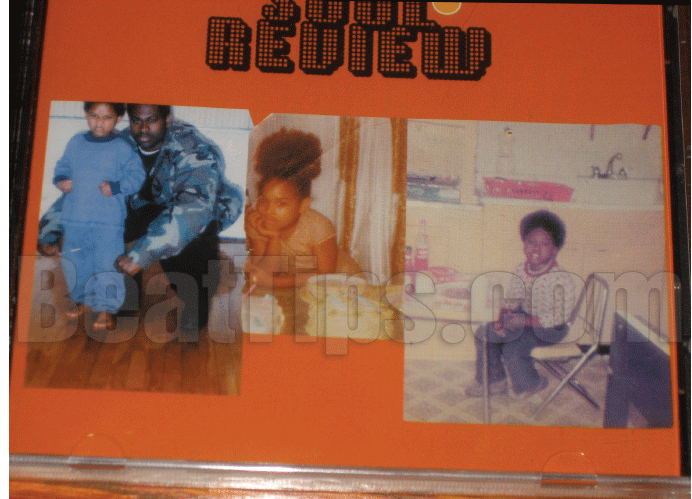
First, DJ Tony Touch. So I’m at home, working on some beats, and Tammy calls. She tells me that not only did she let DJ Tony Touch hear my CD (against my wishes), but that he asked to have it and she let him “hold” it. Before I could erupt with anger, she goes on to tell me that Tony Touch told her to tell me that my song, “Milk is a MONSTER!” and that he would be placing it on his upcoming mixtape. This was pivotal news for several reasons: (1) This was the first time that a known and respected hip hop/rap music insider had validated my music; (2) That he was willing to place my song on his mixtape (free of charge), meant that he really did believe it was a monster; and (3) DJ Tony Touch’s reaction was the exact sort of reaction that I anticipated (hoped for) from a respected hip hop/rap insider. Taking a cue from DJ Tony Touch’s co-sign, I didn’t bother to wait for any more validation; instead, I went to work and made ten new songs. Together with “Milk,” these songs would become my first album, Soul Review.
Several months after Soul Review had been out, catching some street buzz in New York (mostly in Brooklyn, Queens, and the Bronx), I get a call from Marcus Logan, then VP of Marketing at Arista/Star Trak Entertainment. After a series of phone conferences, Logan informs me that he’s worked up three deals for me: (1) An album deal with Arista; (2) A single deal with Motown; and (3) A development deal with Artist Direct that would land significant upfront money. Rather than pursue any of those opportunities presented to me, I told Logan that I was no longer interested in obtaining a major label deal. Thus, I had opted for a path of my own, an independent path. (My ultimate goal was to make music on my own terms, write books, and start a publishing company to give other writers opportunities.) After one last phone conference, in which Logan tried to tell me that I was making a big mistake, and in which I thanked him for all that he done and tried to do for me, I walked away from those opportunities. After that, Marcus Logan and I never spoke again. And I went on to sell out every copy of my album, without any marketing team, promotion, or major label backing.
Two years later, at my request and encouragement, Tammy met with Logan in his office. She presented him with a copy of the Third Edition of my book The BeatTips Manual. Because he had once sincerely believed in me and my music, I had wanted to repay him by including him with my plans for BeatTips. However, whether he had been put off by me turning down the offers that he had worked to get for me, or he had simply found no merit in what I was doing, he showed little interest in being involved, and further advised that, “Without any big names attached to the book, it wouldn’t sell.”
There’s one more thing about this time. Tammy again gave a copy of Soul Review to someone against my wishes. Perhaps because I’d gotten mad at her for letting some people hear the early version of the album, or maybe because she simply forgot, whatever the case, it wasn’t until three years later (around 2004) that she told me that Just Blaze had told her to tell me to “Give him a call!” A missed opportunity? Perhaps. (To this day, Tammy still feels bad about not immediately relaying Just’s message to me.) But funny how things turn out, Just and I would meet some years later and eventually have two pivotal business meetings. He’s one of only a handful of people in the music business that I respect and trust.
Today, The BeatTips Manual is available in it’s Sixth Edition, and it has been bought, read, and used by people and featured at schools all over the world. It includes exclusive interviews with DJ Premier, DJ Toomp, and 9th Wonder, just to name a few; it offers rare, in-depth knowledge on every aspect from history to instruction and process to business; and it has become the corner stone of beatmaking education for countless beatmakers (producers).
When I turned down opportunities that were presented to me 16 years ago, it was an informed decision with the thought of future growth in mind. What I’ve always aimed to do with The BeatTips Manual and The Art of Sampling is to help people do the same: Make informed decisions and grow.

—
The BeatTips Manual by Amir Said (Sa’id).
“The most trusted name in beatmaking.”

From one Hip Hop head to another Milk is real official fam! I’m a fan of the site too, keep up the good work.
Dope story. Dope track.
Yo, that Milk track is bangin fam!
I learn that learned earnest men earn much by learning.